

DISCOVER YOUNG AND CONTEMPORARY ART

Acholi Dance
Thomas Vava
23. November - 15. December 2025
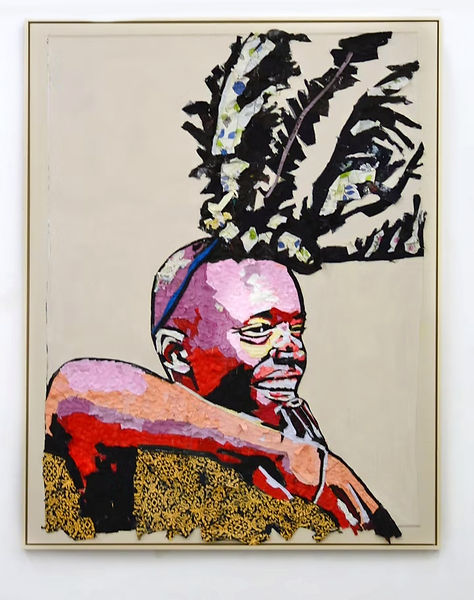
The Ugandan artist Thomas Vava presents a collection of works that place the vibrant culture of the Acholi at center stage. The exhibition includes both large- and small-scale portraits of African icons and role models, as well as dynamic depictions of Acholi dancers and musicians, shown both as individuals and in groups.
The presence of music, dance, and rhythm is palpable in every work and forms the very core of his artistic practice. Vava’s works are characterized by remarkable freshness and boldness. Using vivid colors and strong contrasts, he combines realistic representation with unconventional materials such as garbage bags and plastic waste, which extend beyond the picture plane and lend the works a three-dimensional depth. This choice of materials reflects not only a creative approach, but also an environmental awareness and a critical engagement with issues of waste, pollution, and sustainability.
The works in this exhibition express Vava’s deep appreciation for and affection toward the cultural diversity of his homeland. By merging traditional African art forms with contemporary, sustainable techniques, he creates a powerful synthesis of past and present. These works invite viewers to discover the beauty and dynamism of Acholi culture while simultaneously reflecting on the social and ecological themes embedded in Vava’s practice.



The artist
Thomas Vava, born in 1992 in Uganda, lives and works between Vienna and Uganda. Since 2021, he has been studying at the Academy of Fine Arts Vienna, initially under Hans Ashley Scheirl and currently with Alice Creischer and Andreas Siekmann.
Shortly before beginning his studies, Vava relocated from Uganda to Vienna. His works are already part of numerous private collections. Most recently, his installation Mato Output and a large-scale piece depicting a Cavera dance group were featured at Künstlerhaus Wien as part of the exhibition Passion.
His artistic practice focuses primarily on portraits created from a variety of materials—including recycled plastic scraps, garbage bags, cans, and other everyday found objects. His work exists at the intersection of painting, object art, and social documentation.
