

artcare.app


Dr. Univ. Med. MedR. Prof. Pece
CHRISTIAN LHOTKA
Specialist in Orthopedics and Orthopedic Surgery
Private and KfA physician
Franz-Josefs-Kai 49/14, 1010 Vienna, Austria
Why a medical practice can be more than just a place of treatment
In the Vienna practice of orthopedic specialist Dr. Christian Lhotka, contemporary art is an integral part of the space. Works by international and Austrian artists are on display not only in the waiting area, but also in the treatment rooms and throughout the practice. The selection of artists reflects a range of positions within contemporary art. Among those featured are the Icelandic painter Jakob Veigar Sigurdsson, Austrian artist Hans Weigand, and internationally renowned Danish-Israeli painter Tal R. This spectrum is further complemented by works from Simon Iurino, Josef Kern, Johann Schmid, and Austrian conceptual artist Julius Deutschbauer.
A medical practice is not typically a place where one expects to encounter contemporary art. For artists, this creates an exhibition context beyond the traditional gallery system. For patients, it offers an environment that goes beyond purely functional architecture. While waiting or on the way to treatment, one encounters paintings, photographs, or graphic works, sometimes in passing, sometimes more deliberately.
It is precisely this incidental encounter that gives such presentations their particular appeal. Here, art is not actively sought out as it is in a museum; instead, it becomes part of everyday life - visible to people who might rarely visit galleries.
At the same time, it transforms the atmosphere of a medical setting. Waiting rooms are among the few places in daily life where people are required to pause. In such moments, an artwork can provide distraction, invite focus, or simply serve as a calm visual anchor.

Julius Deutschbauer, Aus Deutschbauer's Pflanzenwelt, 1998
In conversation with Dr. Christian Lhotka
Dr. Christian Lhotka has been a long-standing client of ARTCARE. For many years, he has been presenting contemporary art in his orthopedic practice in Vienna’s first district, realized through ARTCARE’s art rental model. In conversation, he explains that art has become an integral and natural part of his practice.
Dr. Lhotka, you have been exhibiting art in your practice for many years.
What role does it play for you today?
“I can hardly imagine the practice without art anymore,” says Lhotka. “The works shape the atmosphere of the rooms and create an environment that goes beyond the purely functional.”

Through the art rental program, both limited editions and original works are presented. The selection ranges from established artists to emerging positions, including students at Vienna’s art universities and artists who have recently completed their degrees. The works are displayed throughout the entire practice: in the large waiting area as well as in the individual treatment rooms. “No matter where you are in the practice, you almost always have a work of art in view,” Lhotka explains. “It changes the space. The practice feels more vibrant as a result.”
A collection that continues to evolve
The presentation of the works has steadily developed over the years. Together with ARTCARE’s art director Raimund Deiniger, who passed away last year, new works were continuously selected, discovered, and integrated into the practice. “Over time, we’ve rearranged quite a bit,” Lhotka recalls. “Some works suddenly unfold very differently in another location.” This was the case, for example, with a work by Simon Iurino. “At first, I wasn’t sure whether it really fit into the practice,” he remembers. “But after some time and a new placement, it suddenly developed a completely different presence. Today, it’s one of my favorites.”
The powerful, dynamic images of Jakob Veigar Sigurdsson as well as the distinctive visual language of Hans Weigand have also particularly engaged him.
For Christian Lhotka, his commitment to art is not only a matter of design, but also a cultural decision. “It’s a wonderful way to make culture visible and to bring art into everyday life,” he says. “At the same time, it supports young artists and the cultural sector. I sometimes wonder why many more practices don’t do this,” Lhotka adds. “It’s a very straightforward way to integrate high-quality art into one’s own spaces.”
In Austria, art rental also offers companies a tax-efficient way to incorporate artworks into their spaces without having to purchase them outright. For Dr. Lhotka, however, one thing stands above all: “Art changes the atmosphere. And it brings something into people’s everyday lives that goes beyond medical treatment.”


Dr. Christian Lhotka
The practice in Vienna for
modern orthopedic applications

The orthopedic practice of Dr. Christian Lhotka is located in Vienna’s first district on Franz-Josefs-Kai and specializes in modern orthopedic diagnostics and treatment.
As a specialist in orthopedics and orthopedic surgery, Dr. Lhotka has many years of experience and particular expertise in the treatment of conditions and injuries of the musculoskeletal system. His areas of focus include minimally invasive procedures as well as the treatment of knee, hip, and shoulder problems.
The aim of the practice is to help patients achieve greater mobility and quality of life through precise diagnostics, gentle treatment methods, and individualized care.
Dr. Univ. Med. MedR. Prof. Pece
CHRISTIAN LHOTKA
Specialist in Orthopedics and Orthopedic Surgery
Private and KfA physician
Franz-Josefs-Kai 49/14, 1010 Vienna, Austria

What research shows about art in medical environments
That art in such contexts is more than mere decoration is now also the subject of scientific research. In its report What is the evidence on the role of the arts in improving health and well-being?, the World Health Organization (WHO) reviewed more than 3,000 studies on art and health. The analysis concludes that artistic activities and cultural offerings can have positive effects on health, stress management, and overall well-being.
There is also specific research on the effects of visual art in healthcare environments. A systematic review by Foster, Sanhueza, and colleagues, published in 2025 in the journal PLOS One, analyzed 68 studies on art in hospitals and medical practices. The authors show that artworks in medical settings are often associated with lower stress levels, greater well-being, and a more positive perception of the environment - both among patients and staff.
One of the foundational scientific works on the relationship between art and brain research comes from neuroscientist Semir Zeki of University College London. His article Art and the Brain (1998) is considered an early key work in neuroaesthetics and explores how the human brain processes visual information and why art holds a special significance for us.


Josef Kern, From Foreign Gardens, 2000
featured artists
Simon Iurino, Hans Weigand, Tal R,
Julius Deutschbauer, Josef Kern, Pedro Cabrita Reis
Jakob Veigar Sigurdsson, Marcus Oehlen, Johann Schmid

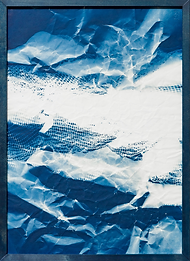


Simon Iurino
Untitled (folded gesture), 2018
Cyanotype on paper
each 70 x 50 cm
Simon Iurino, born in 1986 in Bolzano, Italy, is a contemporary artist who lives and works in Vienna, Austria. He studied in the master class for object sculpture at the Academy of Fine Arts in Urbino, Italy, and subsequently completed a one-year program at the renowned Central Saint Martins in London, United Kingdom. He finished his studies in a master class in text-based sculpture under the well-known professor Heimo Zobernig, with whom he continued to collaborate for several years. Iurino’s work spans a wide range of media, from architectural interventions and installations to sculpture and painting. Across these forms, his practice is united by an engagement with the formal language of modernism. In doing so, the artist seeks to make the material of the image support - canvas, paper - part of the artwork’s content itself.
An important element in Simon Iurino’s sculptures, both large and small in scale, is the use of industrial materials such as copper pipes or extruded ceramic tubes. These sculptures are bent, twisted, and wind their way upward through ceramic screen prints, enamel, and oxides.

Hans Weigand
Untitled, 2009
Oil on canvas
160cm x 190cm
> available works
Hans Weigand (*1954 in Hall in Tyrol) studied at the University of Applied Arts Vienna from 1978 to 1983 in the class of Oswald Oberhuber. Since the late 1970s, he has developed a multifaceted body of work encompassing painting, drawing, printmaking, installations, and collaborative projects. His visual language often combines influences from pop culture, music, film, and subcultures with social and political themes. Motifs such as surfers, landscapes, urban scenes, and references to media and comics recur throughout his work, forming a layered panorama of contemporary life.
Weigand’s works have been exhibited internationally for decades in museums and institutions, including the Secession Vienna, the MAK – Museum of Applied Arts Vienna, the Salzburger Kunstverein, Museum Abteiberg in Mönchengladbach, and the ACLA Museum in Los Angeles. In 2022, the Albertina in Vienna dedicated a comprehensive presentation of his work to him with the exhibition Rider in the Storm. The artist currently lives and works in Vienna and Burgenland.

Julius Deutschbauer
From Deutschbauer’s Plant World, 1998
8 screen prints on Chromolux board
(printed by Andreas Stalzer/Vienna)
Edition 1/100 – 100/100 + 20 E.A.
each 50 cm x 65 cm, signed and dated on the reverse
> available works
Julius Deutschbauer, born in 1961 in Klagenfurt, Austria, is a multidisciplinary artist, performer, and author who lives and works in Vienna. Since 1997, he has been running the “Library of Unread Books,” an ongoing project that collects and presents unread works.
Deutschbauer is known for his poster art, performances, and films, which often reflect social themes with both humor and critical perspective. His works have been presented in numerous exhibitions and performances. In addition to his artistic practice, he was a board member of the IG Bildende Kunst from 2000 to 2007 and is involved in various cultural initiatives.

Josef Kern
From Foreign Gardens, 1999
8 multicolour screen prints on Rives handmade paper
Edition 1/100 – 100/100
each 65 cm x 50 cm, signed and numbered
> available works
Josef Kern, born in 1953 in Schiefer (Styria), studied at the Academy of Fine Arts Vienna from 1972 to 1979 and now lives and works in the Austrian capital. In the 1980s, he was associated with the “Neue Wilde” (New Wild) movement. Throughout his career, Kern has devoted himself both to the depiction of people and to the representation of flowers. His large-scale blossoms and leaves resemble an exuberant herbarium of native flora, expanding vividly and luxuriantly beyond the edges of the image.
Recurring thematic and formal ruptures run through his work, yet its figurative orientation remains a persistent and passionate characteristic of his art. Kern is particularly interested in what is alive and mutable, often incorporating deliberately placed erotic references. At the same time, his works resist simple interpretation or clear categorization. The distinctive figures he carves from linden wood - some partially silvered and developed as reliefs - are as multifaceted as his narrative imagination.
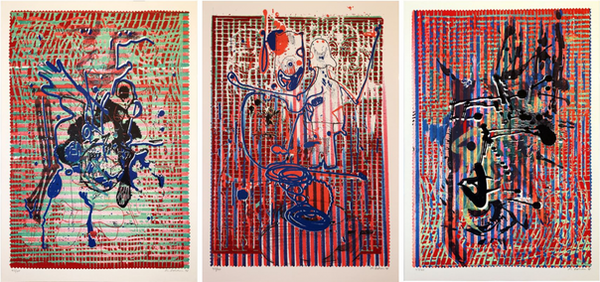
Markus Oehlen
Wotriva I–III, 1998
Multicolour screen print on mat board (three-part series)
Edition 1/60 – 60/60
each 70 cm x 100 cm, numbered and signed
> available works
Marcus Oehlen (*1955 in Krefeld, Germany) is considered one of the significant figures in contemporary German art and has developed a distinctive position since the 1980s at the intersection of painting, music, and experimental media. He studied at the Kunstakademie Düsseldorf from 1976 to 1981 and was part of the circle surrounding the so-called “Neue Wilde” (New Wilds), a generation of artists who responded to the conceptual art of the 1970s with expressive painting and new visual languages. Oehlen works across painting, collage, photography, printmaking, and digital media, often combining abstract structures with graphic elements, text fragments, or technical imagery. His works are characterized by an experimental visual language that interweaves analog and digital processes. Alongside his visual practice, Oehlen is also active as a musician and composer of electronic music, which is reflected in many of his works through rhythmic or structural compositions. Since the 1980s, he has exhibited internationally, including at Museum Ludwig in Cologne, the Museum Moderner Kunst Stiftung Ludwig Wien (MUMOK), Kunstmuseum Bonn, Kunstverein Hamburg, as well as in numerous galleries and institutions across Europe and the United States. Marcus Oehlen currently lives and works in Cologne.

Pedro Cabrita Reis
Untitled, 1997
Screen print on Somerset handmade paper (three-part series)
Edition 1/60 – 60/60
each 70 cm x 100 cm, numbered
> available works
Pedro Cabrita Reis (*1956 in Lisbon, Portugal) is considered one of the most important contemporary artists in Portugal and is internationally recognized for his multifaceted artistic practice. He studied at the Faculty of Fine Arts at the University of Lisbon and presented his first solo exhibition in 1981 at the Sociedade Nacional de Belas Artes in Lisbon. His work encompasses painting, sculpture, drawing, photography, and large-scale installations, often incorporating industrial materials and architectural elements. In his practice, Cabrita Reis frequently engages with questions of space, memory, and perception, combining everyday materials with poetic and philosophical reflections on architecture and landscape. Since the 1980s, he has exhibited internationally and has participated in major exhibitions such as documenta in Kassel, the Venice Biennale, the São Paulo Biennial, and the Lyon Biennale. In 2003, he represented Portugal at the 50th Venice Biennale. His works are now part of numerous important museum collections worldwide, including the Centre Pompidou in Paris, Tate Modern in London, Museo Reina Sofía in Madrid, MAAT in Lisbon, and the Hamburger Kunsthalle.

Jakob Veigar Sigurdsson
Untitled, 2019
Oil on canvas
270cm x 200cm
> available works
For me as an artist, the connection to raw, ever-changing nature is essential. I want to show that nature is not always beautiful. It is beautiful - but it does not always appear the way we want it to. There is no order in untouched nature; it is chaotic, and it is dangerous, surprising, and strange. It is powerful, yet also vulnerable. We can shape it, we can push it, but we should not go too far. And yet, that is exactly what we have done.
With my work, I want viewers to take personal responsibility for their role in this struggle. They should reflect on their patterns of consumption, their superficiality, and their pursuit of pleasure… Is it really this, or is it that, we want? Our perspective is a choice, just like the choice to take responsibility instead of passing it on to others and hoping for the best.We see nature - flowers and butterflies - disappearing behind concrete. It is a warning, but also a whisper of hope. Nature will find a way; it always does, but it may not be the way we hope for.
(Jakob Veigar Sigurdsson – My Art / excerpt)